
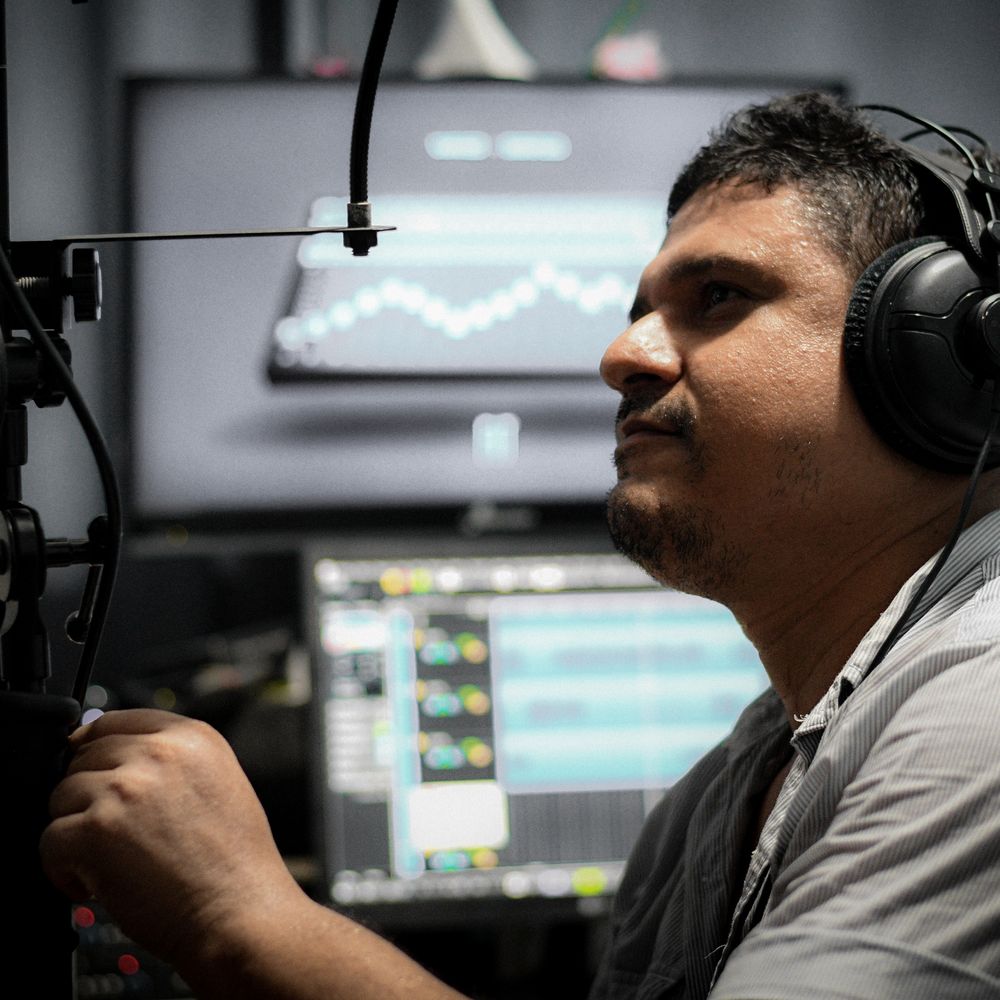

Musicians already own most of the skills a podcast needs, which is why a music show can sound better than many talk shows from its first episode. The gaps are specific, though: loudness, microphone setup, intro length, and music rights. Below are the tips for musicians and podcasters that make the biggest difference, each with the reason behind it so you can bend the rule when your show needs it.
Which tips for musicians and podcasters matter first
Start with your niche and your audio levels. The niche decides what every episode is about, and the levels decide whether a new listener stays past the first few minutes. Everything else is refinement.
Pick a niche you can describe in one sentence
Many musicians assume a music show has to cover everything about music. It doesn't. A show that tries to be about all of music usually ends up being about none of it.
Write your pitch in one sentence: who the show is for and what they'll get. If the sentence needs three commas, the show is still too broad.
One host who interviews musicians learned from a first season that covered many subjects. The second season focused on one group of players, drummers, and gave listeners a reason to pick it. Another music show built each episode around a guest's passion outside music, such as climbing or cooking, and used that angle to draw out the story behind the songs.
Give every voice its own microphone
A single mic shared across a table is the most common shortcut, and it costs you later. The person farther from the mic sounds thin, and when people lean in, the volume jumps. You'll spend hours in editing fixing levels that good placement would have prevented.
Give each speaker a dedicated microphone and record in a quiet room. A pop filter is cheap insurance, because bursts of air from sounds like "p" and "b" can thump the capsule and ruin a take.
Before a real session, record one minute, then play it back on headphones and on a phone speaker. Many listeners hear your show on a phone, so if it sounds thin there, fix it now.
Hit a loudness target, then check the peaks
Loudness is about how loud a show feels over time, and it's measured in LUFS (Loudness Units relative to Full Scale). Peak level is the single loudest instant. You need both numbers to get a clean file.
Last updated: October 2026.
For most podcasts, the common target is -16 LUFS for stereo files and -19 LUFS for mono files. A mono file at -19 LUFS plays at about the same perceived loudness as a stereo file at -16 LUFS, so the two numbers are not a contradiction.
Here's the honest caveat: no formal, official standard exists for podcast loudness. -16 LUFS is a widely used convention, not a law. Pick it, and keep it.
Platforms don't all agree, and that matters if you publish to more than one. Spotify's normalization sits around -14 LUFS and YouTube lands near -13 to -14 LUFS. You'll rarely get a complaint from sitting at -16, but a music video on YouTube will be louder than your podcast feed, and that's fine.
Consistency beats perfection. If one episode is much louder than the last, listeners reach for the volume knob every time they switch shows. Choose your target once, then hold it for the whole run of episodes.
Here's a quick worked example. Say your finished episode measures -12 LUFS. That's loud for a podcast, so you'd bring it down about 4 dB to reach -16. Bringing it down is easy; the harder part is keeping your peaks clean while you do it.
| Output | Integrated loudness target | Peak ceiling |
| Stereo podcast feed | -16 LUFS | -1 dBTP or lower |
| Mono podcast feed | -19 LUFS | -1 dBTP or lower |
| Spotify-focused version | -14 LUFS | -1 dBTP or lower |
| YouTube version | -13 to -14 LUFS | -1 dBTP or lower |
Keep your true peaks at -1 dB or lower. A file can hit its loudness target and still clip, and MP3 encoding often nudges peaks higher than the original recording, so leave headroom before export.
Some editors recommend mixing quieter and normalizing at export. Both approaches work. What matters is the final exported file, so measure that file, not the working project.
Keep your intro music under 20 seconds
Listeners come to hear the conversation or the music, not your theme. Every extra second of intro is a second a new listener might skip before they know whether they like the show.
My rule is 5 to 15 seconds, and 20 seconds as a hard ceiling. If your intro needs longer, the problem is usually the intro, not the length limit.
Test your intro on a phone speaker before you commit. A bass-heavy theme that sounds rich on studio monitors can turn to mud on the small speakers most people use.
For music-led shows, a cold open works better than a formal intro. Start with eight to ten seconds of your best hook, then cut to your name and the episode title.
Release in mono for talk, stereo for music
Stereo panning, where one host sits on the left and another on the right, is a nice effect. It's also the first thing lost when someone listens with one earbud or on a mono speaker. Some listeners hear in mono, so an effect that matters only in stereo is a risk.
For talk-heavy episodes, mono is the safer default. For episodes where the music is the point, stereo keeps the width of the performance.
| Episode type | Format | Why |
| Two or more people talking | Mono | Panned voices can disappear on single-ear or mono playback |
| Solo spoken episode | Mono | Stereo adds file size with no gain for one voice |
| Live session or music-heavy show | Stereo | The width of the mix carries the performance |
Remember to set the loudness target for the format you export. A mono file at -16 LUFS will sound quieter than you expect, so use -19 for mono.
Use only music you have the right to use
Musicians sometimes assume that background music in an episode is harmless because it's a song they like. It isn't. A commercial track in your episode can get the episode taken down, trigger a claim, or cost you a platform account, even when you credit the artist.
Your own recordings are yours, but check every other piece of music. Good options include music you made, music licensed specifically for podcasts, royalty-free libraries with clear terms, and platforms whose licensing covers the music used on them.
One composer who hosts a music show said copyright worry was a big reason he almost didn't start, and that a platform with clear music terms solved that for him. Choosing your platform with licensing in mind is a practical decision, not a minor one.
Copyright rules vary by country, and the details of a license matter. Read the terms before you publish, and if you're not sure a use is covered, talk to a lawyer who works in music or media rights.
Practice before you publish
Musicians rehearse in private before they play for a paying crowd. Podcasters can use the same habit. Record three to five practice episodes with friends or a mentor, then listen back with the goal of fixing one problem per episode.
The first problems are almost always levels, pacing, and too many false starts. Those are much easier to fix in private than in front of a new audience.
Don't let practice turn into an excuse. Set a publish date for episode one, and keep it, even if the episode isn't perfect.
Where to go from here
Pick a niche you can state in one sentence. Set up one mic per speaker, measure your next episode against -16 LUFS for stereo or -19 LUFS for mono, and keep the intro short. Then publish episode one.
How this guide was put together
This guide draws on podcast production guides, interviews with working podcasters, listener discussions, and community threads from people who record music and speech shows. The loudness figures reflect the common targets found across those sources, and the advice on intros, mono, and music rights reflects what hosts describe in their own practice.